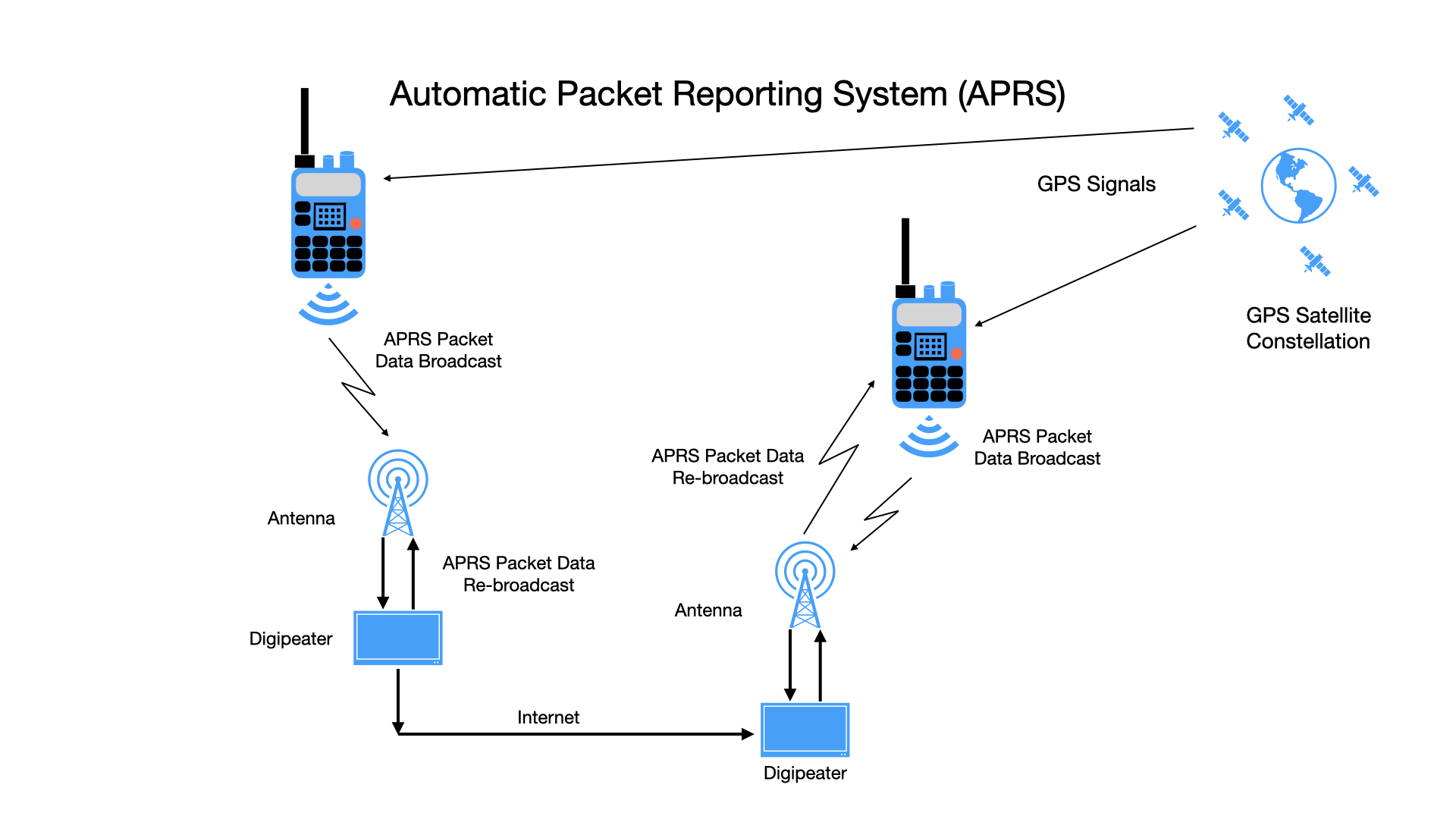
APRS is a digital communications protocol originally developed by Bob Bruninga (WB4APR), a research engineer at the U.S. Naval Academy. APRS lets amateur radio operators share real-time information — including GPS position, telemetry, weather data, short text messages, and alerts — over a shared radio frequency. It is probably most well known for broadcasting position information.
APRS packets are transmitted using the AX.25 packet protocol, typically at 1200
baud using audio frequency-shift keying (AFSK) tones, on a single shared VHF
frequency, 144.390 MHz in North America. Other regions use different frequencies. Some operators also use HF APRS around 10.147 MHz.
Because a radio signal on 2 meters might only travel a few miles, digipeaters often mounted at high elevations that listen for APRS packets and retransmit them. These relay APRS traffic much farther, forming a wide-area APRS network.
Many digipeaters (and dedicated listen-only stations) also act as an Internet Gateway (iGate). They receive APRS packets over RF and forward them onto the APRS Internet System (APRS-IS), a global network of servers. Once on the internet, that data can be viewed from anywhere in the world. APRS sites like aprs.fi, show live maps of APRS stations, weather reports, and message traffic.
The basic pieces of equipment needed for APRS are a transceiver, GPS receiver, a computer, an APRS data encoder/decoder and a Terminal Node Controller (TNC) to translate the digital data to audio tones for the radio.
Today many modern amateur radios include a built-in GPS receiver and APRS encoder/decoder, so they can transmit precise position reports without any extra hardware. Radios without built-in APRS can be connected to a computer or Raspberry Pi running software that acts as a "virtual" TNC. A popular free, open-source option is Dire Wolf, which runs on Windows, Linux (including Raspberry Pi), and macOS and can act as a standalone APRS tracker, digipeater, iGate, or even an APRStt gateway — a clever feature that lets someone with only a basic handheld radio (no GPS or TNC needed) enter position and message data using DTMF touch tones. Smartphone apps like APRSdroid (Android) are also a simple way to get started experimenting with APRS without dedicated radio hardware.
Today a lot of amateur radios, even small handheld and mobile radios, have built-in GPS and are APRS capable so that precise real-time position information can very easily be made available to the network.
Early on a Terminal Network Controller (TNC) connected to a computer was required for APRS. There are now a lot of software packages available that can be used for APRS that provide a virtual TNC. One such free program is Dire Wolf.