
OpenWebRX+ (mostly) Analog Modes (v1.20.120)
One would typically like to divide technologies into audio and digital. OpenWebRX+, though gathers together "listening" modes, or "Audio Modes" here instead. Included are the familiar analog voice modes and a few digital voice modes.
"Listening" Mode Selections
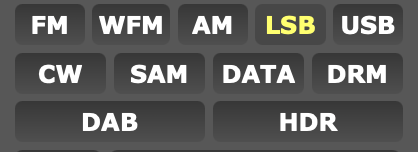
Mode selections on the Receiver Panel
Yellow highlighted FM button label indicates FM mode is selected.
- FM - Narrowband Frequency Modulation
- WFM - Wideband Frequency Modulation
- AM - Amplitude Modulation
- LSB - Lower Sideband (AM)
- USB - Upper Sideband (AM)
- CW - Morse Code
- SAM - Synchronous Amplitude Modulation
- DATA - New digital voice and data protocol
- DRM - Digital Radio Mondiale
- DAB - Digital Audio Broadcasting (European Digital Radio Broadcast Standard)
- HDR - HDRadio (Digital FM Radio Standard in the USA)
Listening Modes in OpenWebRX+
The different modes are useful for different listening purposes and on different bands.
- FM - There are many places where narrowband FM is used. It is popular in the VHF and UHF amateur bands. Many commercial radios use this mode, like GMRS and FRS radios. Marine short-range VHF radios also use this FM mode.
- WFM - Wideband FM is used where audio fidelity is important such as in commercial radio broadcasting in the commercial FM band, 88MHz to 108MHz in the U.S. It is also used in wireless microphones and some high-fidelity audio links.
- AM - Amplitude Modulation is one of the oldest schemes. It is used in AM broadcasting, some aviation voice and Citizens Band (CB) radio.
- LSB - Lower SideBand is used a lot on the amateur bands below 10MHz, i.e. the 160m, 80m and 40m bands. Some CB radios use LSB on select channels for extended range.
- USB - Upper SideBand is used on the amateur bands above 10MHz, 20m, 17m, 15m, 12m and 10m bands. It is also used in some of the VHF and UHF amateur bands.
- SAM - Synchronous Amplitude Modulation is not really a modulation mode but a demodulation technique. It lets you choose between AM sidebands to help with interference from nearby strong signals.