KiwiSDR Operation
When you first connect to the KiwiSDR you will see its main display in your browser. Everything needed to operate the KiwiSDR is presented on this display.
The display appears very similar to the OpenWebRX+ display because KiwiSDR uses a derivative of Jalpb Ketterel's OpenWebRX (an older version).
The KiwiSDR Main Display
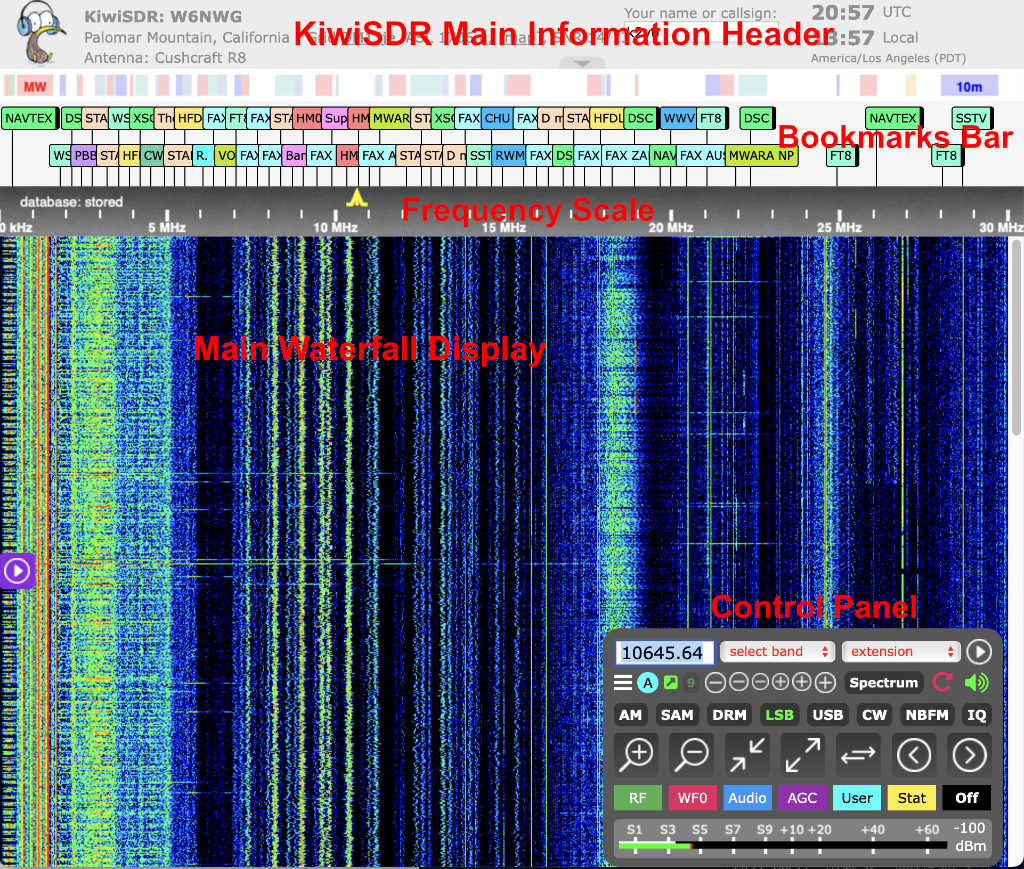
The waterfall shows signal activity over time. The current frequency is indicated by a yellow icon on the Frequency Scale. The colors on the waterfall indicate the signal strength.
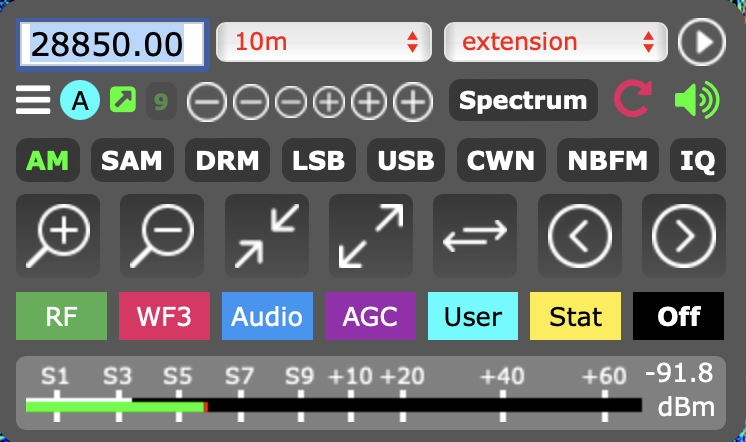
The main controls are located on the Control Panel.
The Control Panel has most of the controls for operating the KiwiSDR including band selection, analog and digital modes and the waterfall display characteristics.
The top row contains the numerical frequency display and drop-down menus for quick band selection and for various extensions.
Below that is a set of frequency tuning buttons, a mute button, a Spectrum toggle button.
The row of analog mode buttons below that let you quickly select analog RF modes (along with an IQ button for raw IQ data).
The row of buttons below these are waterfall controls. These are for zooming the waterfall display and panning in frequency.
The next row of multi-colored buttons open expansion panels that provide controls and information like User which shows connected user information.
At the bottom is an S-meter showing the signal strength. It's useful for indicating whether the Kiwi is being overdriven. If the normally green bar turns red then the signal strength is too high indicating an overload condition on the RF input. This can happen if there are close, strong stations on or near where the frequency the KiwiSDR is tuned to.
| Information and Control Panels | ||
|---|---|---|
| Information Header | Displays general information about the station | It includes the station name, location, the antenna in use and the current time. |
DX Label Header
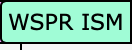 |
Displays a collection of DX Labels each containing a set of saved tuning parameters. When clicked the KiwiSDR tunes to the saved frequency and sets the receiver mode, passband and decoding parameters. | DX Labels (like bookmarks) provide a convenient way to remember and then quickly tune the KiwiSDR to favorite stations. If saved it can even load an extension. |
Frequency Scale

|
A frequency scale is provided above the waterfall display. The selected frequency is denoted with a yellow trapezoidal frequency icon. Its width denotes bandwidth. | The frequency icon is centered on the currently selected frequency and its width indicates the bandwidth corresponding to the currently selected operating mode. ⓘ KiwiSDR Frequency Tuning |
| Control Panel | The Control Panel is used to operate the KiwiSDR. | ⓘ KiwiSDR Control Panel |
Right-click Context Menu
Right-clicking the waterfall opens a context menu. This is kind of a "Power Users" menu. The options are grouped by function to help find what you need:
Database & Bookmarks
• DX EiBi / Community Databases
• DX label filter / Edit labels
• SWBC / Cluster lookups
Tuning & Display
• Snap to nearest / Lock tuning
• Restore passband
• Show/1Hz frequency display
System Tools
• Save waterfall as JPG
• Calibrate ADC (requires admin access)
• Set Freq offset (requires admin access)
• Save noise defaults (requires admin access)
KiwiSDR "sticky" Settings
Another nice feature of the Kiwi is that it will automatically remember some of your selections. These will be activated the next time you connect:
- Name/Callsign field entry
- Frequency selected
- Mode button selection
- Waterfall zoom level
- 9/10 kHz LW/MM band step button setting
- Waterfall/Spectrum settings
- Audio settings
- AGC settings
- Noise blanker/noise filter settings